Pages

Showing posts with label History. Show all posts

The Holy Family

This painting entitled "The Holy Family" depicts St. Elizabeth, Mary, St. Joseph, St. John the Baptist and Jesus.  It is estimated that Peter Paul Rubens created the work between 1615 and 1620 with the assistance of a pupil.  Such collaborative efforts were common for the baroque master at that stage of his career.  At least three other versions of this painting are known to exist.  Mrs. Mary Emery bought this copy in 1912 and displayed it in Edgecliffe - her Cincinnati home.  It was bequeathed to Christ Church in her will in 1927.

The Holy Family has been an important focal point of 
the Boar's Head since the 1950's.
C.K. Wang, photo

In the festival's climax, God comes down to his people. They reach up to God.
C.K. Wang, photo

Rich in Good Works: Mary M. Emery of Cincinnati
We are giving thanks to Mary M. Emery(1844-1927) as parishioners of Christ Church Cathedral prepare for our annual gift to the people of Cincinnati.

In his book, Rich in Good Works: Mary M. Emery Of Cincinnati, art collector and philanthropist, author Millard F. Rogers, Jr. wrote how he was drawn into the life of Mary Emery:

"Mary Emery first attracted my attention during my tenure as director of the Cincinnati Art Museum from 1974 to 1994 when I was in daily contact with the museum building she provided, the endowment she established, and the collection of paintings by Titian, Mantegna, Hals, Murillo, Van Dyck, Gainsborough, and others she bequeathed to that institution. It was not difficult to grasp her methodology in acquiring these master pieces, but so many questions were unanswered about her life, her husband, Emery's acquisition of wealth, and her dedication to charitable acts and the dispersal of most of her estate.”


The Holy Family has been an important focal point of the Boar's Head since the 1950's.
The Boar's Head Festival at the 1835 Church, about 1952
Photo from Boar's Head archive


The Boar's Head Festival at the 1835 Church
Photo from Boar's Head archive

Christ Church was founded in 1817. In 1835, the church moved to its present location at 318 East Fourth Street. The red-brick structure of 1835 was modeled after the old Stepney church St. Dunstan's in London.[1]

The interior was completely redone in the late 1890s, as shown in the above photos. There were Tiffany glass tiles lining the chancel, Tiffany glass hanging lamps, and a sanctuary transformed with a Moorish arch. The Plum Street Temple introduced Moorish architectural design to the city of Cincinnati in 1866. Elements of the 1890s sanctuary were used to create the Ascension Chapel on the 2nd floor of the Parish House.


The Boar's Head Festival at the new Church, about 1957
Photo from Boar's Head archive

The 1835 building, deemed unsafe, was replaced in 1957 with the current building, designed in a bold modern style by David Briggs Maxwell. Although it incorporates features such as the stained glass windows from the original church erected in 1835, the building is in stark contrast to the older buildings in the cathedral complex.


The Boar's Head Festival in the 1980's, 
after church's 1983 renovation
Photo from Boar's Head archive

 In 1982 and 1983, this sanctuary was completing stripped of green tiles on the pyramidal pilasters and argyle diamond pattern (green & gold) on chancel wall and painted off-white everywhere. It was extensively remodeled again in the 1990s.[1]

1. Wikipedia contributors, "Christ Church Cathedral (Cincinnati)," Wikipedia, The Free Encyclopedia,http://en.wikipedia.org/w/index.php?title=Christ_Church_Cathedral_(Cincinnati)&oldid=622369384 (accessed September 20, 2014).

1940 - The First Service

The Boar's Head Festival we know today originated at Queen's College, Oxford, England in 1340. This ceremony was brought to colonial America near Troy, New York by persecuted French Huguenot Protestants who had learned this custom while exiled in England. In 1888 a descendent established this ceremony at the Hoosac Episcopal School. Here Rev. Nelson Burroughs first saw it. He brought it to Cincinnati when he was called to be the Rector of Christ Church in 1939 and gave it a church setting. He was Boar's Head festival's director from 1940 to 1948.
The Rt. Rev. Nelson Marigold Burroughs, seventh Bishop of Ohio, Rector of Christ Church, 1939-1949 


The Hoosac School still exists in Hoosick Falls, NY 
Suzann Parker Leist, photo


"I must tell you that the first celebration of the Boar's Head was really awfully funny," said Bishop Burroughs in a 1994 interview.[2]

"We tried to make some costumes but didn't have time to make all of them," said the bishop. "When the costume rental agency sent us presumably the Boar's Head costumes, they turned out to be outfits from the Prince of Pilsen - a drinking company!"[2]

Boar's Head festival 1940 Cast and Staff, the first service.[1]


At first, following the English custom, there were only men and boys in the cast, fifty in all.  Consequently, in the war years of 1945 and 1946 the ceremony was reduced to a homily with the traditional music.   From 1950 to 1956, while a new church was being built, the festival was held in the Masonic Temple.  When the new church opened in 1957, the Boar's Head processions were expanded to accommodate different aisles and entrances. 

Women joined the ceremony in 1973, opening up new possibilities for 14th-century historical characters and costumes.

The Boar's Head festival has evolved from a light and mellow celebration into a profoundly moving experience. Today, over 350 persons come together in the form of cast, orchestra, choir, and backstage helpers to present Christ Church Cathedral's gift to the city at Christmastide.

1. Morris, J. W. (1967). Christ Church Cincinnati 1817-1967 , Cincinnati, OH: the Episcopal Society of Christ Church
2. "The Rt. Rev. Nelson Marigold Burroughs dies at 99", Interchange March 1999, Retrieved 2014-9-20.

Miner Raymond: the Re-director

November 8, 2014
Miner Raymond, 2009
Festival Director, 1963-1967
Photo courtesy of Miner Raymond

When Christ Church rector Ben Arnold asked Miner Raymond to take over as Boar’s Head director in 1963, both the church and the festival were at turning points. The new church building had been finished a few years earlier and was a statement of recommitment to serving the urban core. And the new nave -- with its openness, aisles and space -- called for a complete rethink of how the festival worked.

Miner, who had led Procter & Gamble brand managers through thousands of intricately planned and executed TV commercials, knew just what to do: He rented a lakeside cabin where he wouldn’t be bothered and opened a pack of 3x5 index cards.

Each card represented one festival performer. He lined them up like toy soldiers and marched them up and down different aisles and in and out different doors until he had worked out an elaborate plan.

Then he took a break. He had a little sailboat with him, and launched it. A stiff breeze came up and gave him a fine, mind-clearing sail.

The breeze also gave him a surprise when he returned to the cabin. “I had left a window open,” he said, “and those cards were scattered everywhere.” So who knows? Perhaps some part of today’s choreography came not from the mind of Miner, but on the wings of the wind.

Miner’s elaborate staging using six entrances into the church nave is still employed today.

The late Gerre Hancock, a renowned organist, was playing at Christ Church in those days. He and Miner thought a more theatrical Boar’s Head called for better music – so Miner, who did a lot of P&G business in New York City, hunted up a Julliard alum named Frank Levy to orchestrate the festival’s vocal and orchestral music to work with the new choreography.

Then one day, while they were in the church working over some of the music, a great piece of luck landed in their laps. A fellow named Maurice Mandell – who had been a New York City Opera cast member – was in the church and heard the music. Being a confirmed ham as well as a fabulous singer, he belted out a couple notes. Miner and Gerre looked at each other and knew just what to do: They convinced Maurice to take the role of Boar’s Head minstrel.

For the next 35 years, Maurice set a musical and acting standard that helped raise the festival to new heights.


And that’s just what Miner had been hoping for: more drama. He even wrote a few quiet measures of organ music to enhance the mood of the festival’s final scene.

High-quality theatrical lighting was another issue on Miner’s mind, and he worried that the church’s more proper Episcopalians might object if he used dramatic lighting to turn their place of worship into a theater. But they didn’t complain a bit. In fact, the mystery and magic created by a top-drawer lighting operation is a point of pride for the church.

P&G work forced Miner to hand off the Boar’s Head directorship after just four years, but his influence is obvious even today. That was in the cards all along.

Director Bob Beiring's 35-year Rope Trick

October 14, 2014
Festival director Bob Beiring giving last minute instructions to the Beefeaters during dress rehearsal, 2006
C.K. Wang, photo
It was 1962. 

East coast bred, Yale educated, bachelor Bob Beiring had just been tapped by his Procter & Gamble bosses at Port Ivory (Staten Island) to head westward to Cincinnati for an industrial engineering job at Ivorydale.

He crammed his worldly possessions--an Evinrude 35 outboard motor, a stereo wrapped in blankets, his pole lamp and clothes--into a tiny U-Haul trailer and pointed his Chevy convertible toward new adventures. 

As he crossed the state line into Ohio, the U-Haul snapped from its tow bar, flew across the road, down an embankment and rested in a heap at the bottom. Bob managed to salvage his Evinrude 35 and his stereo, but, alas, not his pole lamp.

Bob rolled into town and wasted no time: He moved into the old L.B. Harrison Club and reported for work.

The next year Bob was in the Army, under a “critical skills” program. The following year, he returned to P & G to work in a new field called data processing and to finally call Cincinnati home.

It was at the 100th anniversary of Yale’s oldest alumni club later in the year that Bob heard a familiar refrain from a priest: “I have a job for you.”

The Rev. Paul Buckwalter, a fellow Yale man, had recently been hired by Christ Church and quickly determined that Bob was single, relatively new to town, Episcopalian, and had no excuse not to help with the church’s 100-strong Boy’s Club.

Being a gymnast at Yale and a kid at heart, it was a perfect match.

About the same time, parishioner Miner Raymond had assumed the directorship of Christ Church’s Boar’s Head and Yule Log Festival, then in its 22nd year. Miner, whose day job was supervisor of television production for P&G (think commercials for soap operas), and Gerre Hancock, music director, wanted to change the Boar’s Head from a stand-and-sing affair to a more theatrical production.

“I knew nothing of the Boar’s Head to draw me there,” Bob says these days, “but the rest is history.”

Bob joined the cast as a wait, a medieval watchman whose job description included providing entertainment for the castle. Calling on his skills as a gymnast and his love of theater, he began “planting seeds to spice up the roles.”

Over the next few years, he was able to convince the festival directors that he could slide down a rope hung from the organ loft and that he could walk on the back of the church pews.

The year his bloomers split when they got caught on the gallery’s railing sealed the rope descent as a big hit.

Bob kept adding antics to the wait’s job description. He recruited teenagers and adults to walk with him along the backs of the pews, kissing audience members and tickling them with long feathers.

As the 1960s rolled along, the Boar’s Head became more authentic in costuming and props. Theatrical lighting was added, and females were given more important backstage tasks such as prompting and cueing entrances.

In 1973, Bob’s young daughter Lisa asked to be in the Boar’s Head cast. “I didn’t want to tell her that she couldn’t be in it because she was a girl,” Bob said. But, for more than 600 years in England, the festival had been a male-only pageant.

So Bob went to the church hierarchy. As an inducement, he was able to tell them that his wife had promised to make costumes for all female cast members if women were allowed in the cast.

The answer came back “yes”, and holly bearers, ladies of the manor and their attendants and, over time, women in almost every Boar’s Head role joined the cast.


Bob’s interest in growing the festival into a bigger, more theatrical and inclusive performance didn’t go unnoticed. In 1979, he was asked to chair the Boar’s Head. He accepted, and in one stroke of the pen, he was promoted from a wait to the boss.

His timing couldn’t have been worse.

On Dec. 3, 1979, at the concert of the British rock band The Who, festival seating contributed to a stampede and panic that killed 11 people and injured 27 others. The city council quickly ruled that festival seating be banned at all public events. 

Boar’s Head practice had been to let the first 400 people standing in line for each performance go into the sanctuary. Often the line of hopeful audience members circled the church, creating “crushing crowds”, according to Bob. He knew that would have to change.

Bob enlisted the help of a fellow P & G employee and member of the congregation, Suzann Parker Leist, to come up with a plan to convert from festival seating to a ticketed venue. By performance day 1980, a ticketed seating system that she designed was in place. She still keeps a sharp eye on Boar’s Head audience logistics.

The ensuing 34 years have seen a steady infusion of performance improvements. After all, Bob grew up on Radio City Music Hall in the 1950s. He knew what the big-time looked like. A Boar’s Head Rockettes dance group wouldn’t have won universal approval, but first-class theatrical lighting and opera-quality singers like former New York City Opera baritone Maurice Mandell took performances to a very high level. 


Bob Beiring with Chief Minstrel Maurice Mandell, about 1989
Photo credit: Michael Wilson

Today, Bob relies on 300 cast members to show up and make the annual “Miracle on Fourth Street” happen, and he does it without rehearsal. The dress rehearsal is conducted in front of an almost-full house.


Standing ovation from a full house, 2010
C.K. Wang, photo
 
Three more packed performances enchant hundreds more guests – many of whom have never before set foot in Christ Church Cathedral. 

It wouldn’t be an exaggeration to calculate that Bob and all the people who rally around him have touched 84,000 hearts in the last 35 years.

That’s some track record.

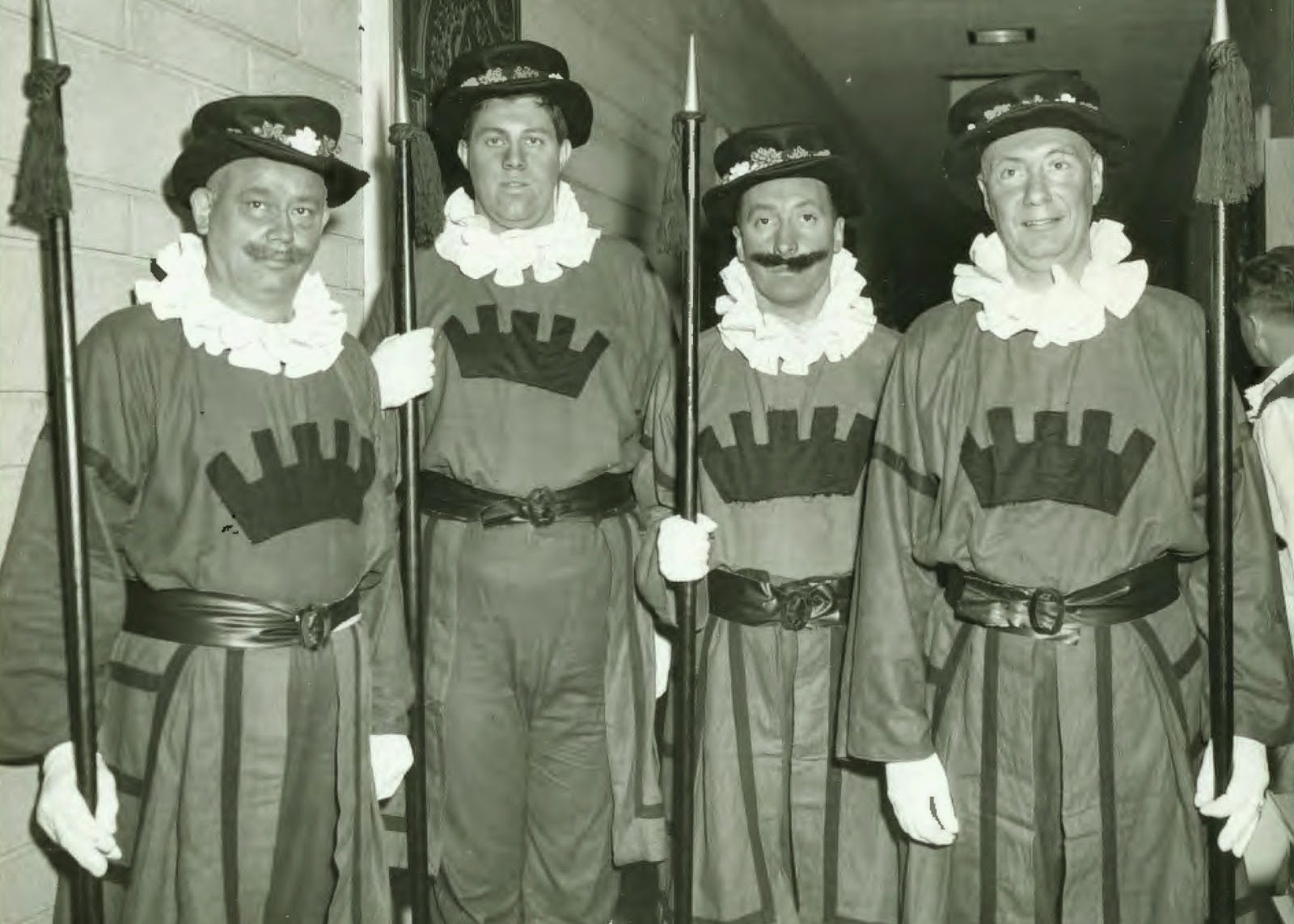
The Beefeaters Heritage

August 23, 2014

"The guards at the Tower of London are called Yeoman Warders. Their nickname is Beefeater. The name Beefeaters is often thought to come from the French word - 'buffetier'. (Buffetiers were guards in the palace of French kings. They protected the king's food.) However, the name Beefeater is more likely to have originated from the time when the Yeomen Warders at the Tower were paid part of their salary with chunks of beef. This took place right up until the 1800s." [1].


On the Road with the Chief Beefeater at the Tower of London

The Beefeaters in the Boar's Head Festival, like their counterparts in the Tower of London, add a festive flair over the performance in their beautiful red uniforms and regimental marching. If you enjoy "pomp and circumstance" with our English roots, come to see the Boar's Head Festival.

Like the real Beefeaters, our performers hold rank as some of the "senior" tenures in the performance, with Phil Hagner holding the title of most senior with 66 years in the 75 year old pageant at Christ Church Cathedral (his secret is that he started as a child sprite).


Beefeaters in the 2006 Festival. Phil Hagner, left front, is the most senior performer. Standing next to Phil is his brother-in-law Ron Lyons.
C.K. Wang, photo

Our Beefeaters red flannel uniforms are an exact replica of the Yeoman Warders (the official name).

"
©2014 Barry Carlin
The State dress uniforms date from 1552 and are worn on state occasions. The uniform consists of a knee-length scarlet tunic, scarlet knee-breeches and stockings, and a round brimmed hat called a Tudor bonnet. Queen Elizabeth I introduced the distinctive white neck ruff.  The uniforms of Yeoman Warders include the thistle, rose and shamrock, emblems of Scotland, England and Ireland.  The Initials ER on their uniforms stand for Elizabeth Regina (Regina is latin for queen).  The initials refer to Elizabeth the Second, who is the present Queen." [1]


Beefeaters in the 1960s - George Schneider, Alan Schatz, 
Greene Gabbard and Theodore Wiche
Photo from Boar's Head archive


Photo from Boar's Head archive

Beefeater George Schneider with Page Mark Pritchard, 1962
Photo from Boar's Head archive


1."The History of the Yeoman Warders and the Yeoman of the Guards.", Project Britain, Retrieved 2014-9-22.